
Everything changed for me the morning I found my car keys in the refrigerator. Honestly, no one warns us about the “menopause brain” quite like that. One minute we’re running a household or a business, and the next, we’re staring at the milk carton, wondering why we even walked into the kitchen.
We all know the drill. The night sweats that make your pajamas feel like a swimsuit. That sudden “all-day tired” that even a third espresso can’t fix. Lately, I’ve been looking for a gentler way to support my body. That’s how I fell back in love with tea. But specifically, the big debate: Matcha vs. Green Tea for Menopause.
Is one actually a “superfood” and the other just a nice drink? Or are we just paying for fancy packaging? I’ve spent weeks digging through the latest research and testing recipes in my own kitchen to find out. If you’re reading this at 2 a.m. because your internal thermostat is broken, I see you. Let’s figure this out together.
But before we even put the kettle on, let’s be honest: a good mug of tea is only one small piece of the puzzle. If your body feels completely out of whack from morning to night, you might be dealing with something much deeper. Before you dive into the matcha debate, take a moment to look at my comprehensive guide to a menopause reset over 50 for 10 powerful, science-backed strategies to get your system out of survival mode without spending a single dime.
1. The “Steel Frame” Secret: Why Your Bones Crave Catechins
Let’s talk about our bones. It isn’t exactly a “sexy” topic, but it’s a big deal for us. As our estrogen levels start to dip, our bones can lose their density faster than we’d like.
I was reading this fascinating paper from the PMC archives recently. Researchers looked at thousands of postmenopausal women in Korea and found something incredible. Those who made green tea a habit had a significantly lower risk of osteoporosis.
The secret lies in the polyphenols. These aren’t just fancy chemicals; they act like a “steel frame” support for your skeletal system. When we look at Matcha vs. Green Tea for Menopause, matcha usually wins on paper. Why? Because you’re consuming the whole leaf. You’re getting a concentrated dose of those bone-building compounds rather than just the “wash” from a tea bag.
2. Keeping Your Heart Happy (and Those Lipids Low)
Heart health becomes a bigger deal for us in this season of life. You might have noticed your doctor getting a bit more “chatty” about your cholesterol numbers lately.
Research suggests that green tea extract can help manage your lipid profile. Specifically, it works on the “bad” LDL cholesterol that we’re all trying to keep in check.
Does this mean you can skip the healthy fats? Of course not. But adding 2 or 3 cups of green tea to your day is a simple, low-effort way to support your cardiovascular system. It’s about those small, daily wins. To be honest, I didn’t expect this part of menopause to be so much about heart health, but here we are.
3. The Breast Density Mystery
This is something no one really talks about in the locker room. Breast density can change as our hormones shift, and it can make mammograms a bit more stressful.
Scientists have actually looked into whether green tea extract affects mammographic density. While the results are still being explored, the fact that these plant compounds are being studied for such specific, woman-centered health concerns is huge.
It makes me feel empowered to know that my morning ritual might be doing more than just waking me up. It’s about taking a proactive seat in our own health journey. FYI, I always feel better knowing I’m doing something proactive between those annual appointments. 🙂
4. The “Oil Can” for Stiff Joints
Ever wake up feeling like your joints need a literal oil can? That “stiff” feeling is often oxidative stress. It’s like our bodies are getting a little bit “rusty” on the inside.
I love this specific finding: combining green tea with something like Tai Chi or gentle movement. A study on women with osteopenia showed that this combination significantly reduced oxidative damage.
It’s the “Life Cookery” way—it’s never just about the food. It’s about how we move and breathe. I’ve started doing five minutes of stretching while my water boils. It’s a small habit, but it makes the tea taste so much better. Tea plus movement equals a stronger you.
5. Managing the “Menopause Blues.”
Honestly, the mood swings are some of the toughest parts of this journey. One minute you’re fine, the next you’re crying at a cat commercial.
Long-term green tea drinkers often report lower levels of depression and anxiety. This is partly because it helps manage inflammation, and partly because of a little something called L-theanine.
L-theanine is the magic ingredient that helps us feel “calmly alert.” It takes the edge off the caffeine, so you don’t get those coffee jitters that make menopause anxiety feel so much worse. If you’re feeling a little lost or “foggy,” this might be the switch you need.
6. Matcha vs. Green Tea: The Power Struggle
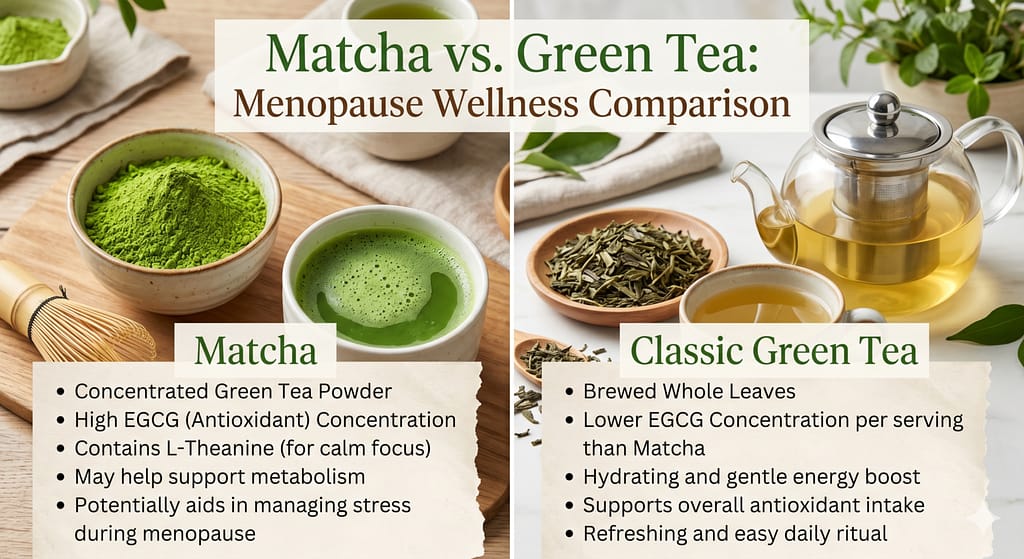
So, is matcha actually the “stronger” sister? The short answer? Absolutely.
When you drink regular green tea, you steep the leaves and then toss them. With matcha, you’re consuming the entire leaf ground into a fine powder.
- Antioxidant Punch: Matcha can have up to 10 times as many antioxidants as a regular cup.
- The Energy Lift: Matcha gives a sustained energy lift that lasts for hours, whereas regular tea is more of a gentle hum.
- The Quality Trap: IMO, always look for “Ceremonial Grade” for drinking. “Culinary Grade” is for baking and can taste quite bitter on its own.
If you’re struggling with morning brain fog, matcha is your best friend. If you’re worried about sleep, stick to a light green tea and stop before noon.
7. The “Pro-Tip” for Iron and Digestion
Here’s a little secret no one tells you: green tea can sometimes interfere with how we absorb iron from our food.
If you’re already struggling with low iron (which can make you feel even more tired), try to drink your tea between meals, not during them. Wait about an hour after eating your protein-rich lunch before reaching for your mug.
Also, watch your water temp! Never use boiling water on green tea or matcha—it burns the leaves and makes them taste like grass clippings. Let the water sit for a minute after boiling. Your taste buds will thank you.
Quick Summary: When comparing Matcha vs. Green Tea for Menopause, matcha is the powerhouse for antioxidants and bone health, while regular green tea is a perfect, gentle companion for heart health and hydration. Aim for 2-3 cups of high-quality tea or 1 bowl of matcha daily. Always listen to your body—if it makes your heart race, dial it back!
Watch: Dr. William Li explains why the choice between Matcha vs. Green Tea for Menopause matters for your cellular health. In this video, the Harvard-trained physician breaks down how tea bioactive compounds support stem cell regeneration and vibrant aging.
The 3 Drinks That Regenerate Stem Cells & Repair The Body | Dr. William Li
Final Thoughts
We’re figuring this out together, one sip at a time. Menopause isn’t about “fixing” ourselves; it’s about nourishing the incredible women we’ve become. So, go ahead and put the kettle on. You deserve this moment of peace.
Be gentle with yourself today.
If you want to know what to drink during intermittent fasting, read this article: What to Drink While Fasting After 50? The Ultimate Guide
Medical Disclaimer
“The content on Blog Life Cookery, including text, graphics, and images related to metabolic health, CGMs, dietary supplements, and hormonal balance, is for informational and educational purposes only. It is not intended as a substitute for professional medical advice, diagnosis, or treatment. Always consult your physician before starting any new supplement regimen, as certain vitamins and minerals may interact with prescription medications. Never disregard professional medical advice or delay seeking it because of anything you have read on this website.”
Affiliate Disclosure:
“In compliance with the FTC guidelines, please assume that some of the links on this website are affiliate links. If you click a link and make a purchase, I may receive a small commission at no extra cost to you. I only recommend products – such as CGM sensors, health trackers, and high-quality supplements – that I have personally tested or thoroughly researched. This support helps keep the ‘Bio-Metabolic Kitchen’ running and providing data-driven insights for women 40+.”