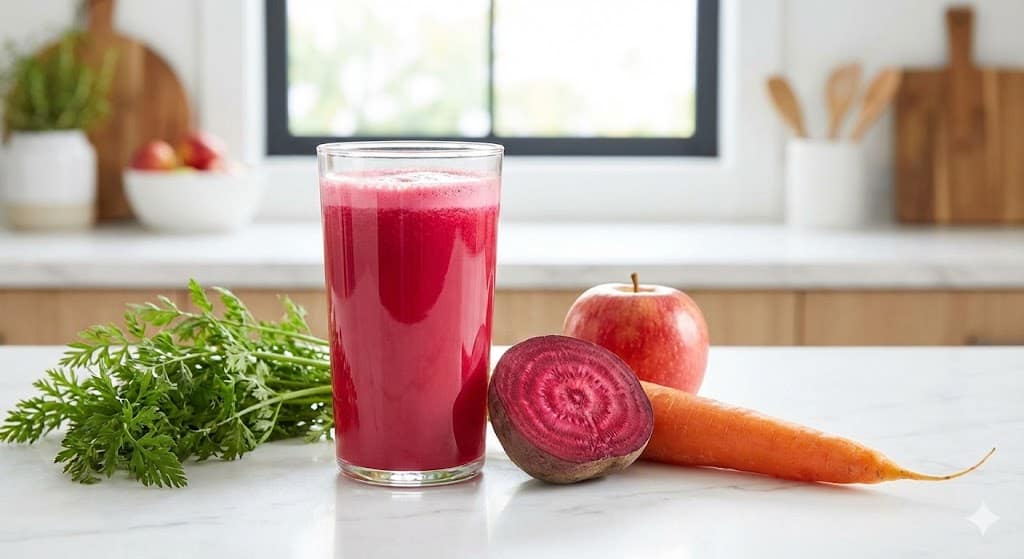
“You just downed a vibrant green drink, but is it actually working? If you’re searching for the best weight loss smoothies over 50, you’ve likely realized that our bodies don’t react to fruit sugar the way they used to.”
Well, I hate to be the one to burst that bubble, but that $12 “detox” drink might be the exact reason your favorite jeans still won’t zip. Most people accidentally build sugar bombs and call them health drinks. I learned this the hard way after months of slurping kale-and-pineapple concoctions only to find my “menopause middle” getting even softer. Your body handles liquid calories differently than solid ones, especially after you hit 50. Ever wondered why you’re starving just sixty minutes after drinking a massive smoothie? It’s all about the insulin spike. If you want to stop the cycle of “drink, spike, crash, and crave,” you need to rethink your blender strategy. I’m sharing the exact mistakes I made so you don’t have to repeat them. We’re turning your morning sip into a metabolic anchor.
🍎 The Fruit Trap: Natural Sugar is Still Sugar
I know, I know. It’s fruit! It’s from the earth! How could it be bad? The problem lies in the concentration and the liver. When you eat a whole apple, the fiber slows down the sugar absorption. When you blend three apples, two bananas, and a splash of orange juice, you’re basically sending a sugar freight train straight to your bloodstream.
Your liver is the only organ that processes fructose. When you overwhelm it with a massive dose of liquid fruit sugar, it doesn’t have time to burn it for energy. Instead, it converts that excess sugar directly into triglycerides. This leads to fat storage, often right in the liver and around your organs. Does that sound like a “detox” to you? :/
Your Liver Doesn’t Care if it’s “Organic”.
I used to think that because I bought organic, high-end frozen mangoes, my body would treat them differently than it would a candy bar. Spoiler alert: It didn’t. My blood sugar still spiked, and my insulin still skyrocketed. Insulin is the master fat-storage hormone. If your insulin is high, your body physically cannot burn stored fat.
The Hidden Fructose Danger
Liquid fructose bypasses the usual satiety signals in your brain. Have you ever noticed that you can drink 500 calories of fruit in two minutes, but you could never eat that much whole fruit in one sitting? The mechanical act of chewing releases signaling hormones like CCK and GLP-1. Without them, your brain thinks you’re still hungry.
💪 The Protein Gap: Why 30g is Your Magic Number
If you’re over 50, you’re likely dealing with Anabolic Resistance. This is just a fancy way of saying your muscles are becoming “stubborn” and require more effort to maintain. I see so many women adding a tiny half-scoop of protein and wondering why they feel weak. You need a “Leucine trigger” to keep your metabolism firing.
Research suggests that women in menopause need 30-40 g of protein per meal. This isn’t just for bodybuilders; it’s for anyone who wants to keep their bones strong and their metabolism active. Protein has the highest thermic effect of food, meaning your body burns more calories just trying to digest it.
Breaking Down Anabolic Resistance
Why does this happen as we age? Hormonal shifts, specifically the drop in estrogen, change how we synthesize protein. If you don’t hit that 30g threshold, your body won’t “turn on” the muscle-building machinery. You end up losing muscle mass, which lowers your resting metabolic rate. It’s a downward spiral I see way too often.
Whey Isolate vs. Collagen vs. Plant Protein
Which one should you pick? IMO, Whey Isolate is the gold standard for muscle protection. It contains the highest concentration of Leucine. However, if dairy makes you bloat, I recommend a high-quality Beef Isolate or a Pea/Rice blend. Don’t rely solely on collagen for your 30g; it’s great for skin, but it’s not a complete protein for muscle repair.
🌾 The Fiber Bridge: Your Natural GLP-1
Ever heard of the “Ozempic effect”? You can trigger a similar, natural satiety response using fiber. I call fiber the “metabolic bridge” because it slows down the transit time of your smoothie through your gut. This prevents the insulin spike that leads to fat storage.
I aim for 10-15 grams of fiber in every smoothie. Most people are lucky to get 2 grams from a few leaves of spinach. Fiber feeds your gut microbiome, which in turn produces short-chain fatty acids that help regulate your weight.
Chia vs. Flax: The Ultimate Showdown
I personally prefer ground flaxseeds over chia seeds for hormone balance. Flaxseeds contain lignans, which help modulate estrogen levels. However, chia seeds are fantastic for that “pudding” texture. Both are fiber powerhouses that keep you full until lunch.
Why Spinach Isn’t Enough
Don’t get me wrong, I love a handful of greens. But spinach is mostly water. You would need to blend an entire bag of greens to get the fiber you need to stabilize your blood sugar. Treat greens as a micronutrient boost, not a fiber source. Use seeds, acacia fiber, or psyllium husk to do the heavy lifting.
🥑 Smart Fats: The Satiety Signal You’re Skipping
If protein is the fuel and fiber is the bridge, fat is the anchor. I used to be terrified of adding fat to my smoothies. I thought more fat in the blender meant more fat on my hips. I was so wrong. Fat slows down gastric emptying even more than fiber. Healthy fats signal your brain that you are full. Without fat, your smoothie is just a fast-acting carb. I noticed a massive difference in my focus and energy once I started adding a tablespoon of almond butter or some MCT oil. You stop thinking about food for hours.
Almond Butter vs. MCT Oil
Which one is better for your goals? I love almond butter for the Vitamin E and minerals. However, MCT oil is a biohacker favorite because it bypasses the normal digestive process and goes straight to the liver, where it’s converted into ketones for brain fuel. FYI, start slow with MCT oil, or your stomach might not be your friend for a few hours. 🙂
🚫 Hidden Saboteurs: Are These Wrecking Your Progress?
Sometimes it’s not what’s missing; it’s what you’re adding. I see “healthy” influencers constantly adding honey, agave, and maple syrup to their smoothies. Why? The fruit is already sweet! Agave is almost 80% fructose, which is a nightmare for your liver.
Watch out for flavored nut milks. That “Original” almond milk usually has 7 to 10 grams of added cane sugar per cup. Always choose “Unsweetened.” Even coconut water can be a sugar trap if you’re using it as a base for an already fruity smoothie.
The Juice Myth
Are you still using orange or apple juice as your liquid base? Please, for the love of your metabolism, stop. Juice is just fruit with the soul (the fiber) ripped out of it. Use water, unsweetened nut milk, or even chilled green tea instead. You’ll save 120 calories and 25 grams of sugar instantly.
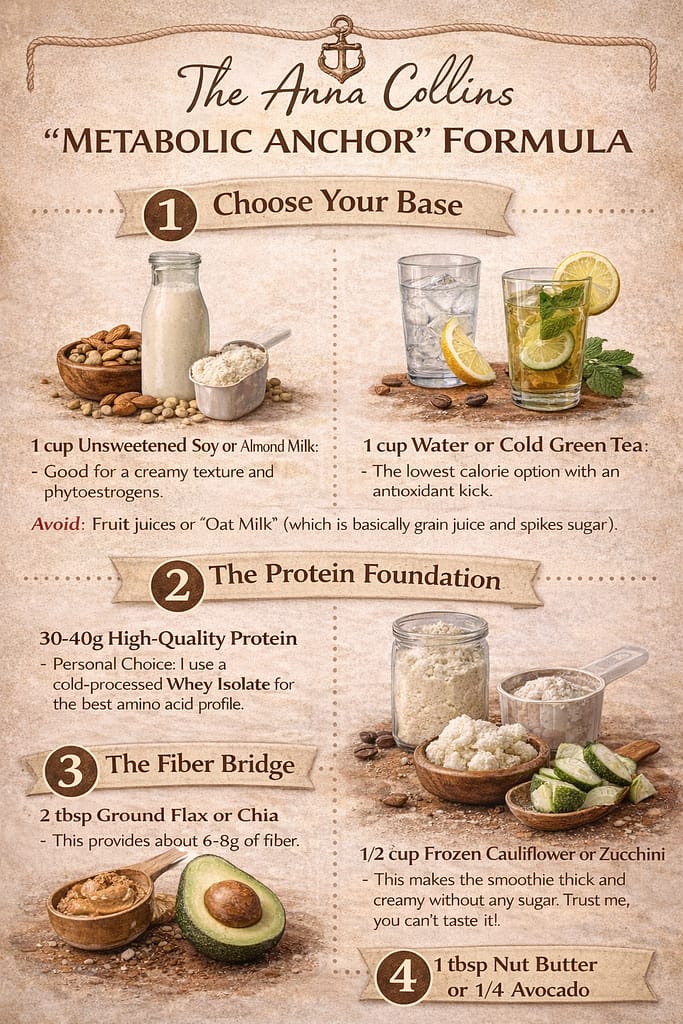
🥗 The Anna Collins “Metabolic Anchor” Formula
Ready to fix your blender game? I’ve spent years perfecting this formula to ensure I feel energized and lean, not bloated and hungry.
Step 1: Choose Your Base
- 1 cup Unsweetened Soy or Almond Milk: Good for a creamy texture and phytoestrogens.
- 1 cup Water or Cold Green Tea: The lowest calorie option with an antioxidant kick.
- Avoid: Fruit juices or “Oat Milk” (which is basically grain juice and spikes sugar).
Step 2: The Protein Foundation
- 30-40g High-Quality Protein: This is your non-negotiable.
- Personal Choice: I use a cold-processed Whey Isolate for the best amino acid profile.
Step 3: The Fiber Bridge
- 2 tbsp Ground Flax or Chia: This provides about 6-8g of fiber.
- 1/2 cup Frozen Cauliflower or Zucchini: This makes the smoothie thick and creamy without any sugar. Trust me, you can’t taste it!
Step 4: The Smart Fat
- 1 tbsp Nut Butter or 1/4 Avocado: This anchors the meal.
“While protein is the anchor of your metabolism, your liver is the filter. To see faster results with your ‘menopause middle,’ I recommend starting with my [7-Day Liver-Support Smoothie Reset] to clear the path for your new protein-rich lifestyle.”
🥤 Chewing vs. Sipping: The Thermic Effect
Is it better to eat your calories or drink them? Thermodynamically, chewing whole food burns slightly more calories. The energy required to break down a steak and a stalk of broccoli is higher than a pre-blended liquid.
However, smoothies offer incredible nutrient density. The trick is to “sip, don’t chug.” I try to take 15 to 20 minutes to finish my smoothie. This gives my hormones time to signal to my brain that I’m actually eating. If you inhale it in three gulps, your brain won’t register the calories, and you’ll be looking for a snack by 11:00 AM.
🧘 Why Your Morning Routine Matters for Cortisol
If you drink a high-sugar smoothie on an empty stomach, you’re asking for a cortisol spike. Your body perceives that massive insulin surge as a stressor. This is especially bad for women over 50 who are already struggling with “cortisol belly.”
I always recommend drinking your smoothie after a glass of water. This hydrates your cells and prepares your digestive tract. Keeping your morning calm and your blood sugar stable is the best way to ensure your body stays in “fat-burn mode” all day long.
🏁 Conclusion: Take Back Your Blender
So, is your smoothie stalling your progress? It might be, but it doesn’t have to stay that way. By moving away from the “fruit bomb” model and embracing the Protein-Fiber-Fat triad, you turn a drink into a powerful metabolic tool. I noticed my cravings vanished within three days of making these simple swaps.
Stop over-complicating it with expensive “superfood” powders and start focusing on the macros. Add the protein, boost the fiber, and don’t fear the fat. Your liver, your waistline, and your energy levels will thank you. Are you ready to build a smoothie that actually works for your body?
I’d love to see your creations! Tag me in your “Metabolic Anchor” photos or drop a comment below. Let’s reclaim our health, one blender jar at a time. 🙂
Medical Disclaimer
“The content on Blog Life Cookery, including text, graphics, and images related to metabolic health, CGMs, dietary supplements, and hormonal balance, is for informational and educational purposes only. It is not intended as a substitute for professional medical advice, diagnosis, or treatment. Always consult your physician before starting any new supplement regimen, as certain vitamins and minerals may interact with prescription medications. Never disregard professional medical advice or delay seeking it because of anything you have read on this website.”
Affiliate Disclosure:
“In compliance with the FTC guidelines, please assume that some of the links on this website are affiliate links. If you click a link and make a purchase, I may receive a small commission at no extra cost to you. I only recommend products – such as CGM sensors, health trackers, and high-quality supplements – that I have personally tested or thoroughly researched. This support helps keep the ‘Bio-Metabolic Kitchen’ running and providing data-driven insights for women 40+.”